AiRNex Private Jet Booking App (Case Study)
Simplifying a High-Trust, High-Value Booking Experience
Client
AiRNex
Services
Aviation
Timeline
4 weeks
Overview
Product:
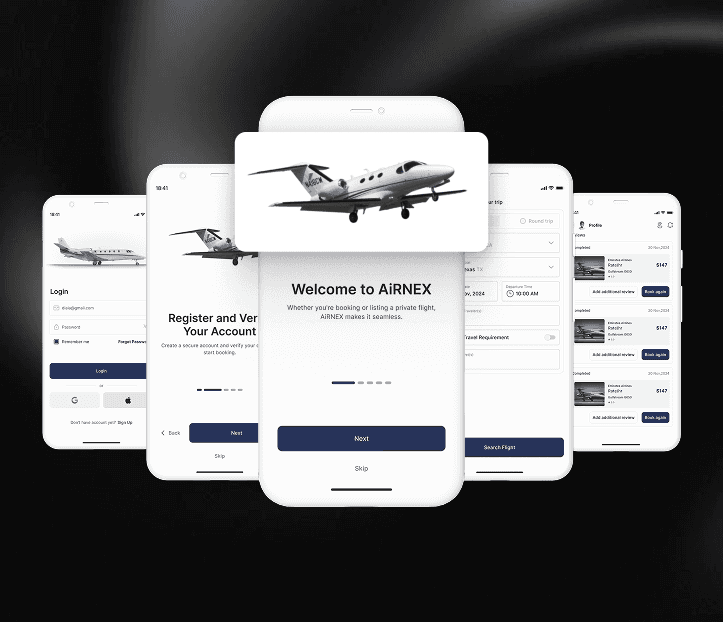
AiRNex Private Jet Booking App
Role:
Product Designer (UI/UX)
Platform:
Mobile
Project Type:
New product (0 → 1)
Responsibility:
UX strategy, interaction design, UI, and developer handoff
Team:
Worked with 1 PM & 2 Developers
Context
AiRNex set out to make private jet booking more accessible and efficient without compromising the premium experience expected by high-net-worth users. Unlike traditional travel apps, this product operates in a high-risk, high-value environment where trust, clarity, and speed are critical.
I worked closely with stakeholders to translate business goals into a mobile experience that reduced friction while maintaining credibility and perceived luxury.
Problem Statement
Early discovery highlighted three key challenges:
Existing booking flows were long, complex, and unintuitive.
Users needed absolute clarity before committing to high-value transactions.
Trust signals were often buried or inconsistently presented.
The core challenge was balancing speed and simplicity with transparency and confidence.
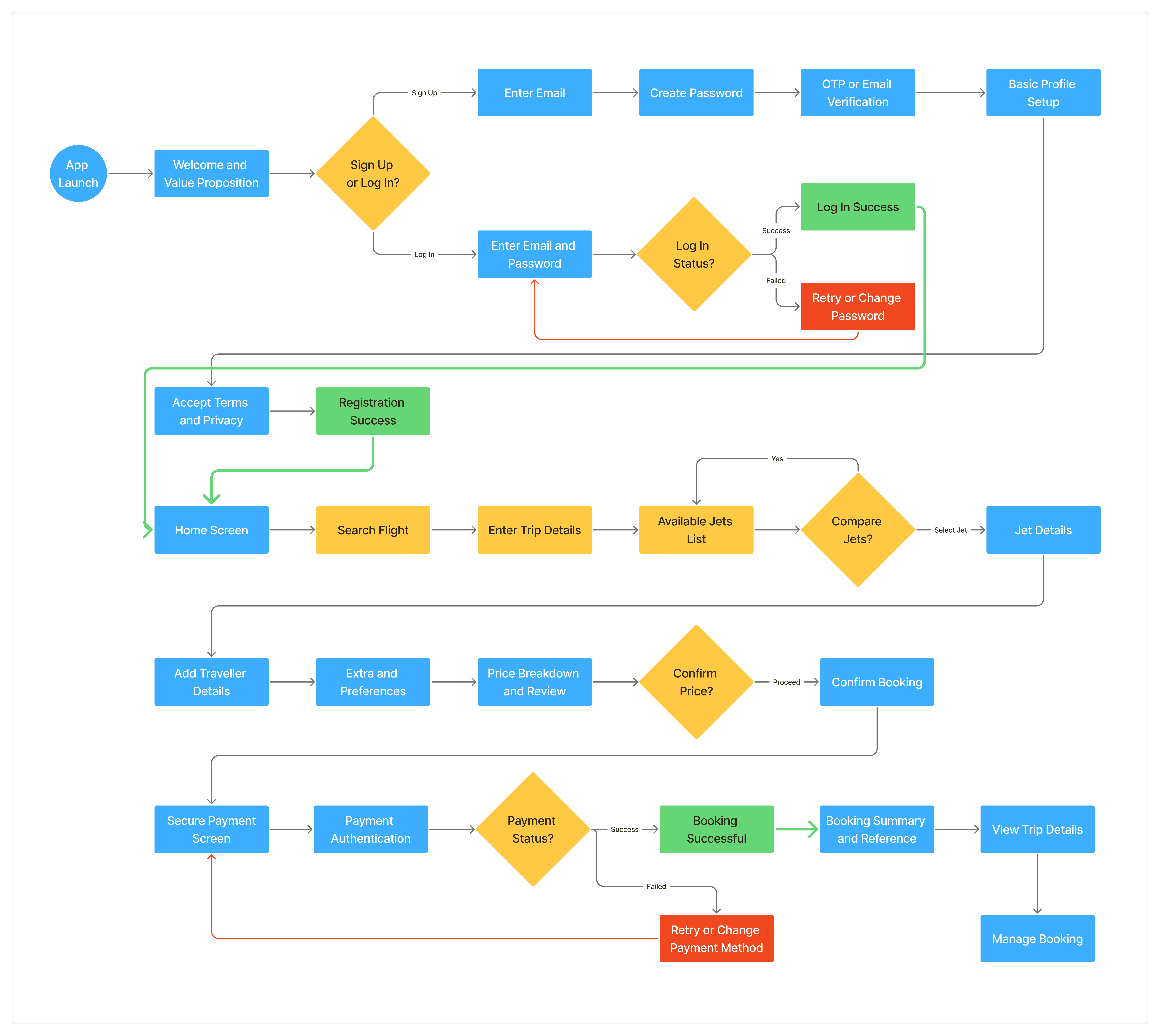
End-to-End Flight Booking User Flow
User Personas
Target Audience Profiles for Baedy Event Celebration Website
The Business Executive

Name:
David Okoye
Age:
35
Gender:
Male
Occupation:
CEO / Founder
Location:
Lagos, Nigeria
Travel Frequency:
2–4 private flights per month
Goals
Book flights fast with minimal friction.
Avoid delays, layovers, and crowded airports.
Trust the app with high-value transactions.
Motivations
Time efficiency.
Privacy & security.
Reliability over price.
Pain Points
Too many steps during booking.
Unclear pricing.
Repeating passenger details every time.
Key UX Needs
Fast registration (OTP only)
Clear jet comparison screen.
One-tap rebooking.
Transparent price breakdown.
The Luxury Leisure Traveler

Name:
Amara Bello
Age:
34
Gender:
Female
Occupation:
Entrepreneur / Lifestyle Influencer
Location:
Dubai, UAE
Travel Frequency:
1–2 trips per month
Goals
Experience luxury and comfort.
Customize her flight (catering, pets, preferences).
Feel confident she’s making the “best choice”.
Motivations
Comfort.
Status.
Visual clarity & reassurance.
Pain Points
Technical aviation jargon.
Confusing aircraft differences.
Hidden fees.
Key UX Needs
Rich jet detail screens.
Simple language (not aviation terms).
Visual cues for luxury level.
Clear confirmation screen.
The Operations / Charter Manager

Name:
Michael Reed
Age:
38
Gender:
Male
Occupation:
Corporate Travel Manager
Location:
Albu-dahbi, UAE
Travel Frequency:
Weekly bookings for executives
Goals
Book flights accurately.
Manage multiple passengers.
Keep records and references.
Motivations
Accuracy.
Control.
Accountability.
Pain Points
Re-entering passenger data.
Managing changes or cancellations.
Lack of booking history.
Key UX Needs
Saved passenger profiles.
Booking history dashboard.
Clear booking reference.
Easy change/cancel flow.
Goals & Success Criteria
Reduce friction across the booking journey.
Enable users to compare and select flights quickly.
Reinforce trust at every decision point.
Deliver a premium yet usable mobile experience.
Success was evaluated through flow efficiency, task completion speed, and qualitative stakeholder and early user feedback.
My Role & Approach
1. Defining Critical User Moments
I mapped the end-to-end booking journey and identified the moments where users were most likely to hesitate or abandon:
Searching for available flights.
Comparing options and pricing.
Reviewing aircraft and booking details.
Confirming the booking.
These moments became primary design focus areas.
2. Flow Simplification & Information Hierarchy
To reduce friction, I:
Consolidated multi-step flows into fewer, clearer steps.
Grouped information logically to support faster decision-making.
Prioritized essential details while progressively revealing secondary information.
This helped users stay oriented and confident throughout the process.
3. Interaction & UX Design
I designed interactions to feel:
Predictable and responsive.
Calm and deliberate rather than flashy.
Focused on reducing cognitive load during high-stakes decisions.
Micro-interactions and visual feedback were used intentionally to reinforce trust.
4. Visual System & UI
The visual language was designed to:
Communicate premium quality without visual noise.
Maintain consistency across complex flows.
Scale as additional services and features are introduced.
Typography, spacing, and color were carefully controlled to support clarity.
The Solution
The final product is a streamlined private jet booking app that enables users to search, compare, and book flights with significantly reduced friction while maintaining a premium, trustworthy experience.
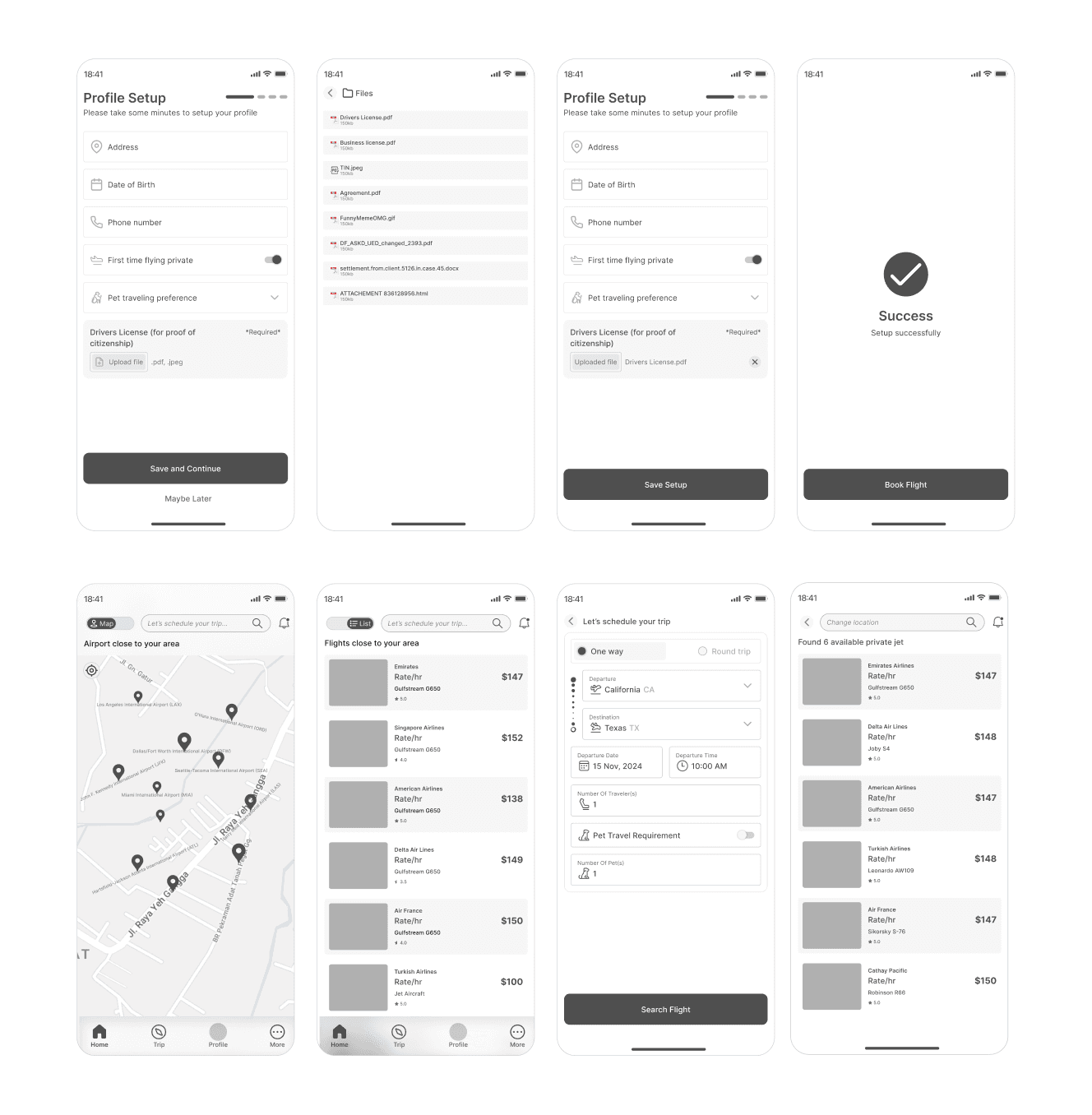
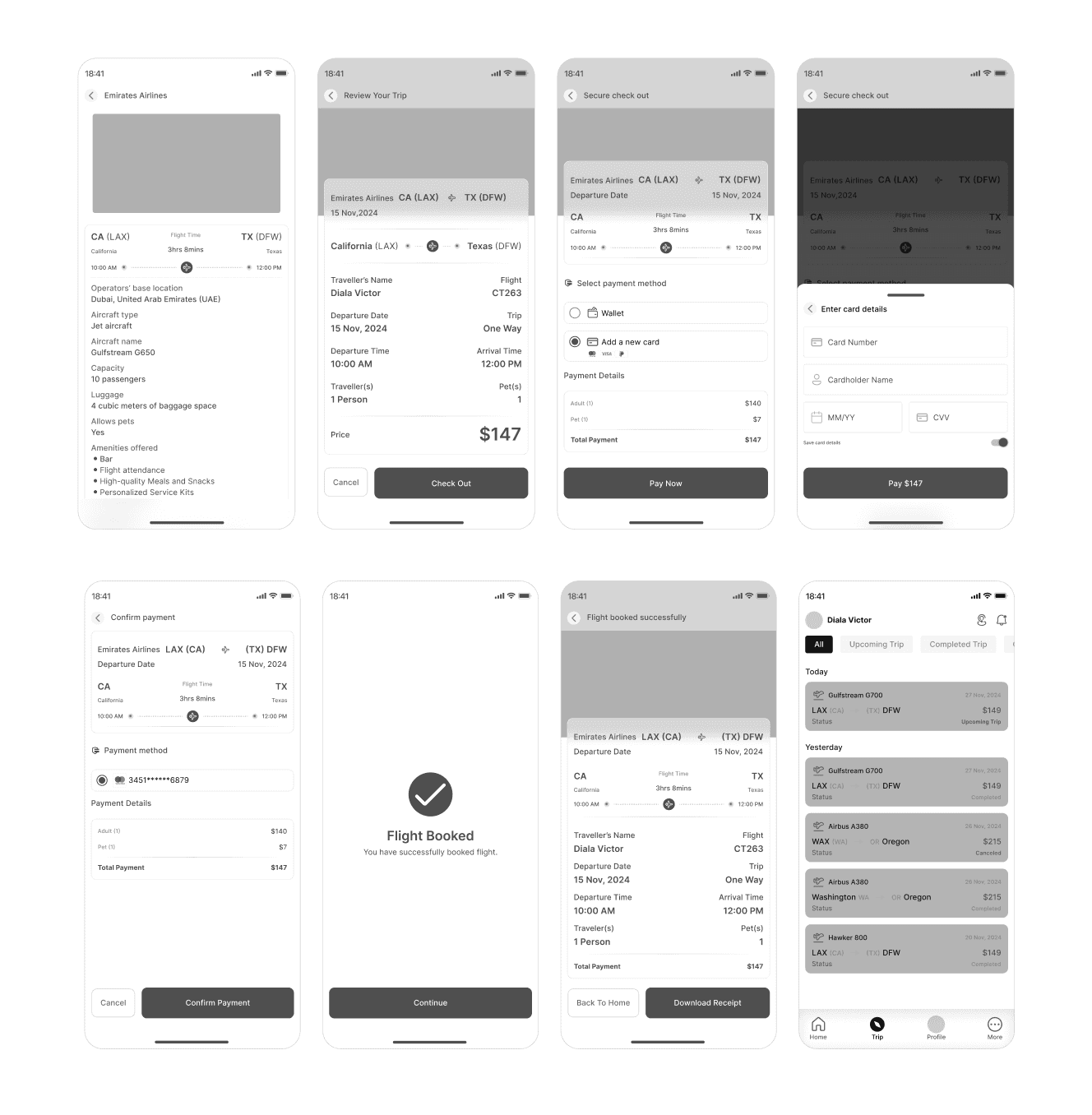
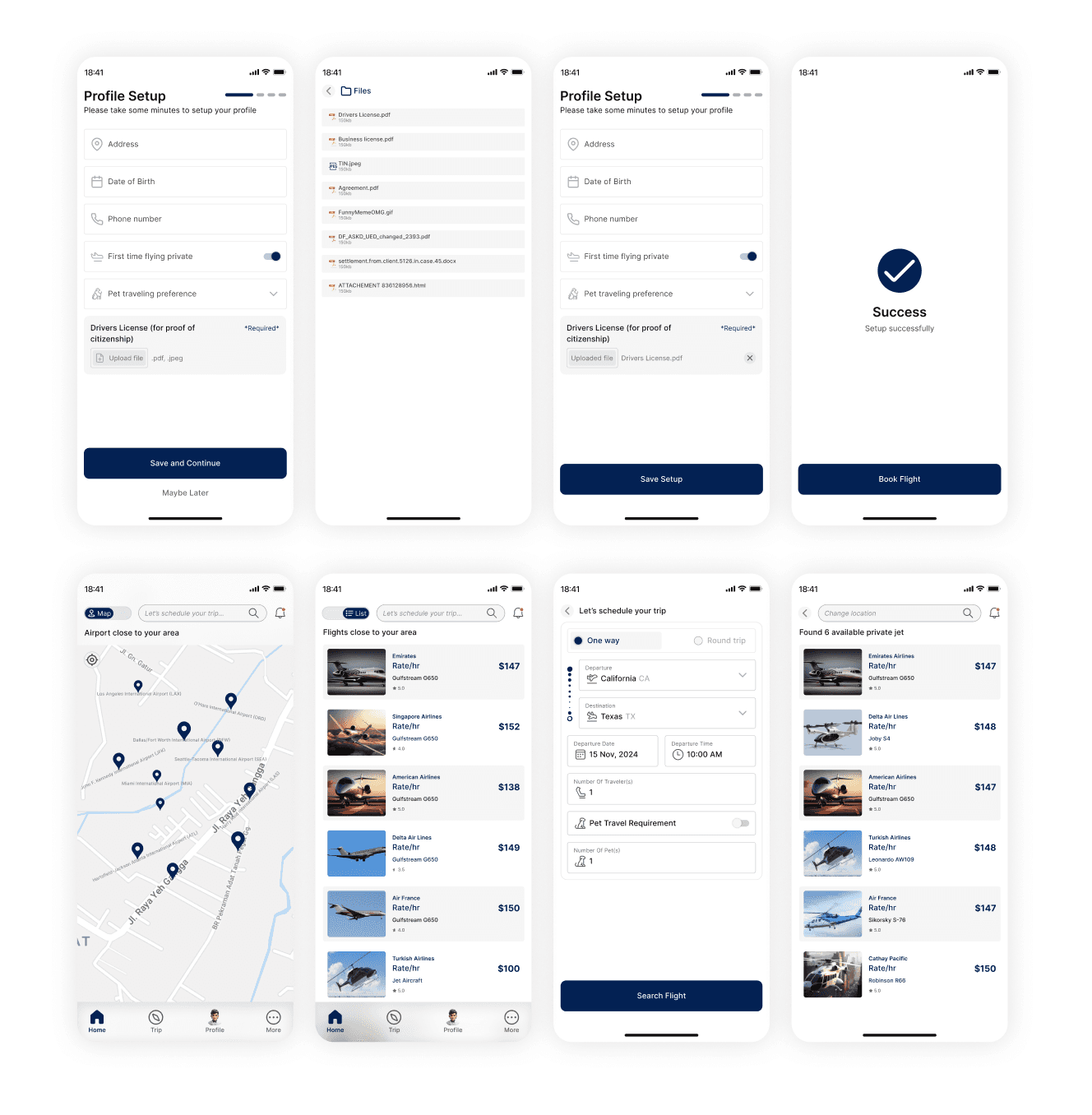
Wireframe (Profile Setup/Booking Process)
Outcome & Impact
Reduced booking flow steps by 35–40%.
Improved task completion speed for core booking actions.
Early usability reviews indicated fewer points of hesitation during key decision moments.
Established a scalable foundation for future features and services.
Trade-offs & Decisions
Reduced visible options in early steps to avoid decision overload.
Deferred advanced filtering to later stages of the flow.
Chose clarity and restraint over heavy visual decoration.
Key Learnings
In high-value products, trust is built through clarity, consistency, and thoughtful restraint. Removing friction is not about removing information, but about presenting the right information at the right time.
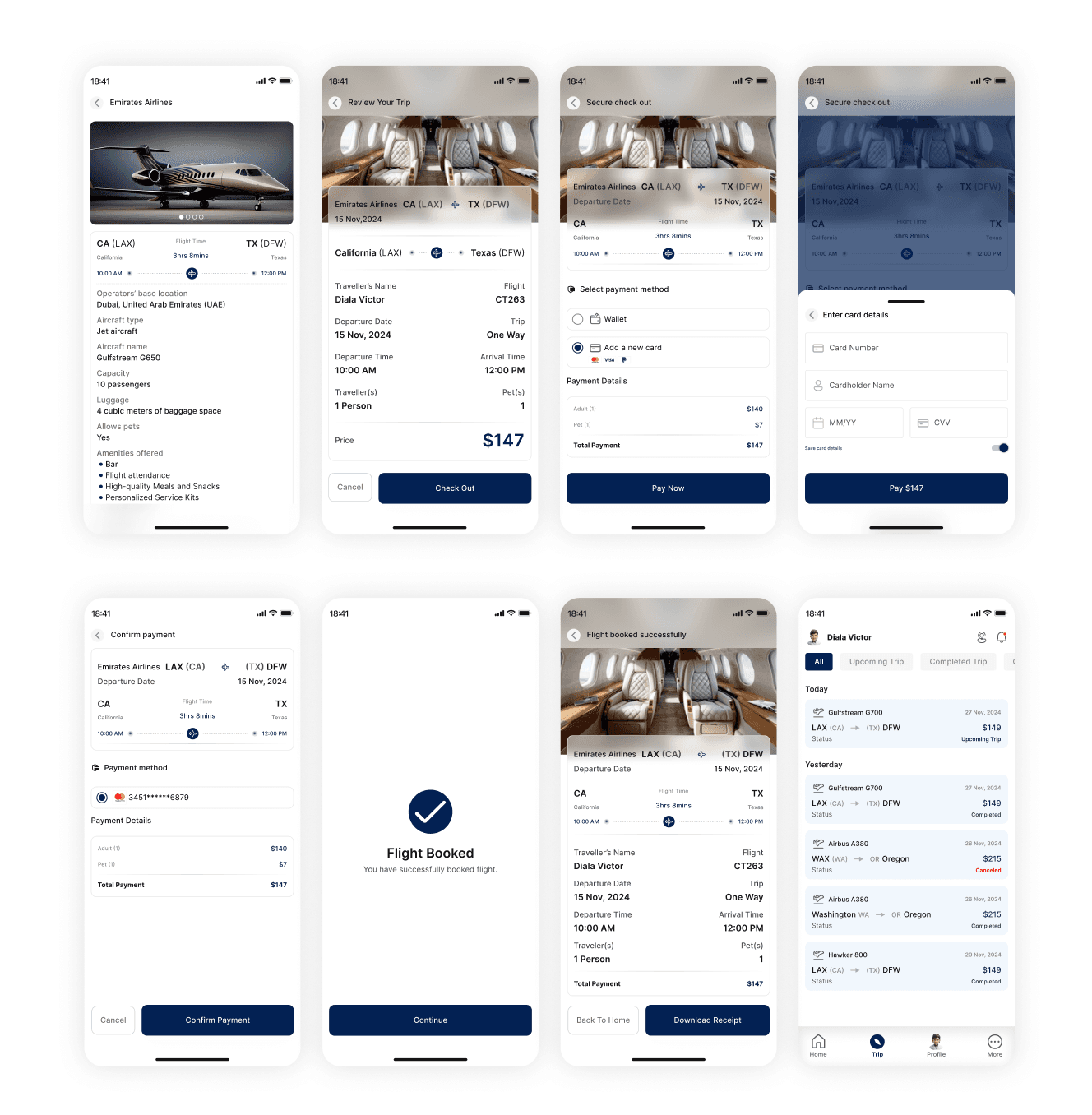
High Fidelity Design (Profile Setup/Booking Process)
Other Project
AiRNex Private Jet Booking App (Case Study)
Simplifying a High-Trust, High-Value Booking Experience
Client
AiRNex
Services
Aviation
Timeline
4 weeks
Overview
Product:
AiRNex Private Jet Booking App
Role:
Product Designer (UI/UX)
Platform:
Mobile
Project Type:
New product (0 → 1)
Responsibility:
UX strategy, interaction design, UI, and developer handoff
Team:
Worked with 1 PM & 2 Developers
Context
AiRNex set out to make private jet booking more accessible and efficient without compromising the premium experience expected by high-net-worth users. Unlike traditional travel apps, this product operates in a high-risk, high-value environment where trust, clarity, and speed are critical.
I worked closely with stakeholders to translate business goals into a mobile experience that reduced friction while maintaining credibility and perceived luxury.
Problem Statement
Early discovery highlighted three key challenges:
Existing booking flows were long, complex, and unintuitive.
Users needed absolute clarity before committing to high-value transactions.
Trust signals were often buried or inconsistently presented.
The core challenge was balancing speed and simplicity with transparency and confidence.
End-to-End Flight Booking User Flow
User Personas
Target Audience Profiles for Baedy Event Celebration Website
The Business Executive
Name:
David Okoye
Age:
35
Gender:
Male
Occupation:
CEO / Founder
Location:
Lagos, Nigeria
Travel Frequency:
2–4 private flights per month
Goals
Book flights fast with minimal friction.
Avoid delays, layovers, and crowded airports.
Trust the app with high-value transactions.
Motivations
Time efficiency.
Privacy & security.
Reliability over price.
Pain Points
Too many steps during booking.
Unclear pricing.
Repeating passenger details every time.
Key UX Needs
Fast registration (OTP only)
Clear jet comparison screen.
One-tap rebooking.
Transparent price breakdown.
The Luxury Leisure Traveler
Name:
Amara Bello
Age:
34
Gender:
Female
Occupation:
Entrepreneur / Lifestyle Influencer
Location:
Dubai, UAE
Travel Frequency:
1–2 trips per month
Goals
Experience luxury and comfort.
Customize her flight (catering, pets, preferences).
Feel confident she’s making the “best choice”.
Motivations
Comfort.
Status.
Visual clarity & reassurance.
Pain Points
Technical aviation jargon.
Confusing aircraft differences.
Hidden fees.
Key UX Needs
Rich jet detail screens.
Simple language (not aviation terms).
Visual cues for luxury level.
Clear confirmation screen.
The Operations / Charter Manager
Name:
Michael Reed
Age:
38
Gender:
Male
Occupation:
Corporate Travel Manager
Location:
Albu-dahbi, UAE
Travel Frequency:
Weekly bookings for executives
Goals
Book flights accurately.
Manage multiple passengers.
Keep records and references.
Motivations
Accuracy.
Control.
Accountability.
Pain Points
Re-entering passenger data.
Managing changes or cancellations.
Lack of booking history.
Key UX Needs
Saved passenger profiles.
Booking history dashboard.
Clear booking reference.
Easy change/cancel flow.
Goals & Success Criteria
Reduce friction across the booking journey.
Enable users to compare and select flights quickly.
Reinforce trust at every decision point.
Deliver a premium yet usable mobile experience.
Success was evaluated through flow efficiency, task completion speed, and qualitative stakeholder and early user feedback.
My Role & Approach
1. Defining Critical User Moments
I mapped the end-to-end booking journey and identified the moments where users were most likely to hesitate or abandon:
Searching for available flights.
Comparing options and pricing.
Reviewing aircraft and booking details.
Confirming the booking.
These moments became primary design focus areas.
2. Flow Simplification & Information Hierarchy
To reduce friction, I:
Consolidated multi-step flows into fewer, clearer steps.
Grouped information logically to support faster decision-making.
Prioritized essential details while progressively revealing secondary information.
This helped users stay oriented and confident throughout the process.
3. Interaction & UX Design
I designed interactions to feel:
Predictable and responsive.
Calm and deliberate rather than flashy.
Focused on reducing cognitive load during high-stakes decisions.
Micro-interactions and visual feedback were used intentionally to reinforce trust.
4. Visual System & UI
The visual language was designed to:
Communicate premium quality without visual noise.
Maintain consistency across complex flows.
Scale as additional services and features are introduced.
Typography, spacing, and color were carefully controlled to support clarity.
The Solution
The final product is a streamlined private jet booking app that enables users to search, compare, and book flights with significantly reduced friction while maintaining a premium, trustworthy experience.
Wireframe (Profile Setup/Booking Process)
Outcome & Impact
Reduced booking flow steps by 35–40%.
Improved task completion speed for core booking actions.
Early usability reviews indicated fewer points of hesitation during key decision moments.
Established a scalable foundation for future features and services.
Trade-offs & Decisions
Reduced visible options in early steps to avoid decision overload.
Deferred advanced filtering to later stages of the flow.
Chose clarity and restraint over heavy visual decoration.
Key Learnings
In high-value products, trust is built through clarity, consistency, and thoughtful restraint. Removing friction is not about removing information, but about presenting the right information at the right time.
High Fidelity Design (Profile Setup/Booking Process)
Other Project
AiRNex Private Jet Booking App (Case Study)
Simplifying a High-Trust, High-Value Booking Experience
Client
AiRNex
Services
Aviation
Timeline
4 weeks
Overview
Product:
AiRNex Private Jet Booking App
Role:
Product Designer (UI/UX)
Platform:
Mobile
Project Type:
New product (0 → 1)
Responsibility:
UX strategy, interaction design, UI, and developer handoff
Team:
Worked with 1 PM & 2 Developers
Context
AiRNex set out to make private jet booking more accessible and efficient without compromising the premium experience expected by high-net-worth users. Unlike traditional travel apps, this product operates in a high-risk, high-value environment where trust, clarity, and speed are critical.
I worked closely with stakeholders to translate business goals into a mobile experience that reduced friction while maintaining credibility and perceived luxury.
Problem Statement
Early discovery highlighted three key challenges:
Existing booking flows were long, complex, and unintuitive.
Users needed absolute clarity before committing to high-value transactions.
Trust signals were often buried or inconsistently presented.
The core challenge was balancing speed and simplicity with transparency and confidence.
End-to-End Flight Booking User Flow
User Personas
Target Audience Profiles for Baedy Event Celebration Website
The Business Executive
Name:
David Okoye
Age:
35
Gender:
Male
Occupation:
CEO / Founder
Location:
Lagos, Nigeria
Travel Frequency:
2–4 private flights per month
Goals
Book flights fast with minimal friction.
Avoid delays, layovers, and crowded airports.
Trust the app with high-value transactions.
Motivations
Time efficiency.
Privacy & security.
Reliability over price.
Pain Points
Too many steps during booking.
Unclear pricing.
Repeating passenger details every time.
Key UX Needs
Fast registration (OTP only)
Clear jet comparison screen.
One-tap rebooking.
Transparent price breakdown.
The Luxury Leisure Traveler
Name:
Amara Bello
Age:
34
Gender:
Female
Occupation:
Entrepreneur / Lifestyle Influencer
Location:
Dubai, UAE
Travel Frequency:
1–2 trips per month
Goals
Experience luxury and comfort.
Customize her flight (catering, pets, preferences).
Feel confident she’s making the “best choice”.
Motivations
Comfort.
Status.
Visual clarity & reassurance.
Pain Points
Technical aviation jargon.
Confusing aircraft differences.
Hidden fees.
Key UX Needs
Rich jet detail screens.
Simple language (not aviation terms).
Visual cues for luxury level.
Clear confirmation screen.
The Operations / Charter Manager
Name:
Michael Reed
Age:
38
Gender:
Male
Occupation:
Corporate Travel Manager
Location:
Albu-dahbi, UAE
Travel Frequency:
Weekly bookings for executives
Goals
Book flights accurately.
Manage multiple passengers.
Keep records and references.
Motivations
Accuracy.
Control.
Accountability.
Pain Points
Re-entering passenger data.
Managing changes or cancellations.
Lack of booking history.
Key UX Needs
Saved passenger profiles.
Booking history dashboard.
Clear booking reference.
Easy change/cancel flow.
Goals & Success Criteria
Reduce friction across the booking journey.
Enable users to compare and select flights quickly.
Reinforce trust at every decision point.
Deliver a premium yet usable mobile experience.
Success was evaluated through flow efficiency, task completion speed, and qualitative stakeholder and early user feedback.
My Role & Approach
1. Defining Critical User Moments
I mapped the end-to-end booking journey and identified the moments where users were most likely to hesitate or abandon:
Searching for available flights.
Comparing options and pricing.
Reviewing aircraft and booking details.
Confirming the booking.
These moments became primary design focus areas.
2. Flow Simplification & Information Hierarchy
To reduce friction, I:
Consolidated multi-step flows into fewer, clearer steps.
Grouped information logically to support faster decision-making.
Prioritized essential details while progressively revealing secondary information.
This helped users stay oriented and confident throughout the process.
3. Interaction & UX Design
I designed interactions to feel:
Predictable and responsive.
Calm and deliberate rather than flashy.
Focused on reducing cognitive load during high-stakes decisions.
Micro-interactions and visual feedback were used intentionally to reinforce trust.
4. Visual System & UI
The visual language was designed to:
Communicate premium quality without visual noise.
Maintain consistency across complex flows.
Scale as additional services and features are introduced.
Typography, spacing, and color were carefully controlled to support clarity.
The Solution
The final product is a streamlined private jet booking app that enables users to search, compare, and book flights with significantly reduced friction while maintaining a premium, trustworthy experience.
Wireframe (Profile Setup/Booking Process)
Outcome & Impact
Reduced booking flow steps by 35–40%.
Improved task completion speed for core booking actions.
Early usability reviews indicated fewer points of hesitation during key decision moments.
Established a scalable foundation for future features and services.
Trade-offs & Decisions
Reduced visible options in early steps to avoid decision overload.
Deferred advanced filtering to later stages of the flow.
Chose clarity and restraint over heavy visual decoration.
Key Learnings
In high-value products, trust is built through clarity, consistency, and thoughtful restraint. Removing friction is not about removing information, but about presenting the right information at the right time.
High Fidelity Design (Profile Setup/Booking Process)